Health & Safety Policy — House Clearance Dalston
Purpose: This policy describes the commitments and controls that govern safe working practices for our house clearance and rubbish removal operations. It applies to all staff, contractors and subcontractors engaged in clearance services and rubbish collection activities within our service area. The intent is to reduce risk to employees, clients, the public and the environment while delivering professional waste removal services.Scope and Policy Statement
The company maintains a proactive approach to health and safety across every site and vehicle operation. Our policy covers manual handling, vehicle safety, hazardous materials management, infection control, and site risk control during domestic and commercial clearances. All clearance services, including skip-less rubbish removal and general waste transfer, must be undertaken in accordance with this policy and prevailing waste regulations. House Clearance Dalston operations will follow documented procedures to ensure consistency and legal compliance.
Responsibilities
Management is responsible for establishing safe systems of work, conducting risk assessments, providing training, and ensuring appropriate equipment and personal protective equipment (PPE) are available. Supervisors must verify site controls are in place, confirm permits where required and enforce safe working standards. Operatives are required to follow instructions, use PPE, report hazards and attend training. Contractors engaged for additional clearance services must demonstrate equivalent standards and safety competence before work begins.Risk Assessment and Planning
Before any removal, a site-specific risk assessment will be completed to identify hazards such as unstable structures, asbestos, sharps, hazardous liquids, and vermin. Where practicable, control measures are implemented before work starts. This includes segregation of recyclables and non-recyclables, safe access arrangements, traffic management where vehicles operate near public thoroughfares, and clear signage for operational zones. Planning minimises manual handling by using trolleys, lifting aids and vehicle tail lifts.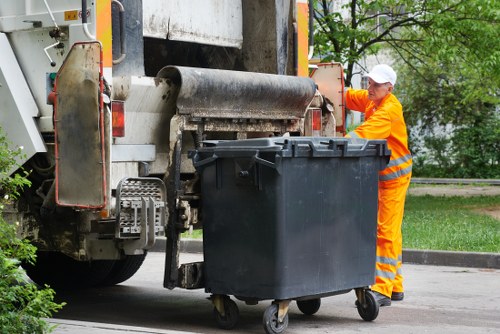
PPE, Equipment and Training
All staff will be provided with adequate PPE including gloves, safety boots, hi-visibility clothing, eye protection and respiratory protection where indicated by risk assessment. Equipment maintenance schedules ensure tools, lifting aids and vehicles are safe and compliant. Training is mandatory for manual handling, hazardous waste awareness, safe driving of company vehicles and incident reporting procedures. Refresher training will be scheduled regularly and whenever procedures change.Hazardous Materials and Waste Handling
Handling hazardous items requires strict controls. Asbestos, chemicals, batteries, solvents, oils and medical waste are identified and segregated. Items suspected of containing asbestos will be left untouched and reported for specialist removal. Sharps and contaminated materials are placed in secure containers and managed under appropriate waste transfer protocols. The company will comply with hazardous waste consignment procedures and arrange licensed disposal through authorised waste carriers.Operational Controls
Safe systems of work for rubbish removal Dalston and surrounding areas include safe loading practices, correct use of tail lifts, vehicle restraint systems and secure covering of loads during transit. Lone working policies and check-in procedures reduce the risks for operatives working unsupervised. Working at height is controlled by training and equipment such as stepladders with appropriate risk assessment. Traffic management plans are used when operations impact pavements or roads.
Emergencies, First Aid and Incident Reporting
Emergency arrangements are in place for fire, spillage and medical incidents. Adequately stocked first aid kits and trained first aiders will be available on-site or in vehicles where practicable. All incidents, near misses and injuries must be reported promptly and investigated to prevent recurrence. Records of accidents and remedial actions will be maintained in accordance with legal requirements.
Monitoring, Contractor Management and Compliance
To ensure ongoing safety performance, the company conducts scheduled audits, toolbox talks and periodic reviews of procedures. Contractors and sub-contractors used for clearance services must provide evidence of their safety management, insurance and competence. The company monitors compliance with waste regulations, vehicle standards and health and safety legislation relevant to waste removal operations. Insurance, licences and permits are maintained as required for lawful rubbish collection and disposal.Communication and Workforce Involvement
Clear communication channels ensure safety information reaches all team members. Tool-box talks, written safe operating procedures and visual prompts on vehicles and sites support day-to-day safe working. Workers are encouraged to participate in safety reviews and to report hazards using established channels. House clearance specialists must demonstrate awareness of hazard controls and actively contribute to continuous improvement.Audit, Review and Continuous Improvement
This policy will be reviewed at least annually or when significant changes occur in operations, legislation or after major incidents. Findings from audits and incident investigations will inform training, equipment investment and changes to operational procedures. A documented review cycle ensures the policy remains effective and aligned with the best practice for waste removal and clearance services.
Commitment
The organisation firmly commits to protecting people and the environment while delivering professional clearance services. By implementing the controls outlined, maintaining training and insisting on contractor competence, we aim for continual reduction of risk in all house clearance and rubbish company activities within our service area.